
Sullivan County Civil Docket Searches
For a first look, try the Sullivan TnCIS public search. Pick Civil first. Then choose Circuit Court, General Sessions, or Clerk and Master. Search by party name, case year, or case number. A multi-word name gets easier when you tick the Match all search terms box. Expect a possible CAPTCHA, and know that results cap at 2,500 rows.
When nothing comes back, check the court route before blaming the name. Probate, equity, divorce, conservatorship, and partition matters often belong to the Clerk and Master. General Sessions usually holds small claims and lower-dollar civil cases. If the record is not online, call the right clerk. You can also visit, or mail a written copy request.
- Identify the court from a notice, pleading, or case number.
- Select Civil and the matching court type in TnCIS.
- Search the exact party name, then narrow by year or number.
- Read the court, status, next date, and disposition fields together.
- Request the filed document or certified order from its custodian.
Sullivan Civil Docket Search Controls
The public form is lean. There is no date-range picker, no status menu, no attorney field, and no export button. Its court checkboxes carry the real weight. They route a civil docket search to the correct division. The portal also says nothing about coverage span or refresh rate. It stays quiet on whether document images are free to view. A subscription login on the landing page is separate from the public case form. The official Sullivan search interface lays out the fields used for both Circuit and lower-court searches.
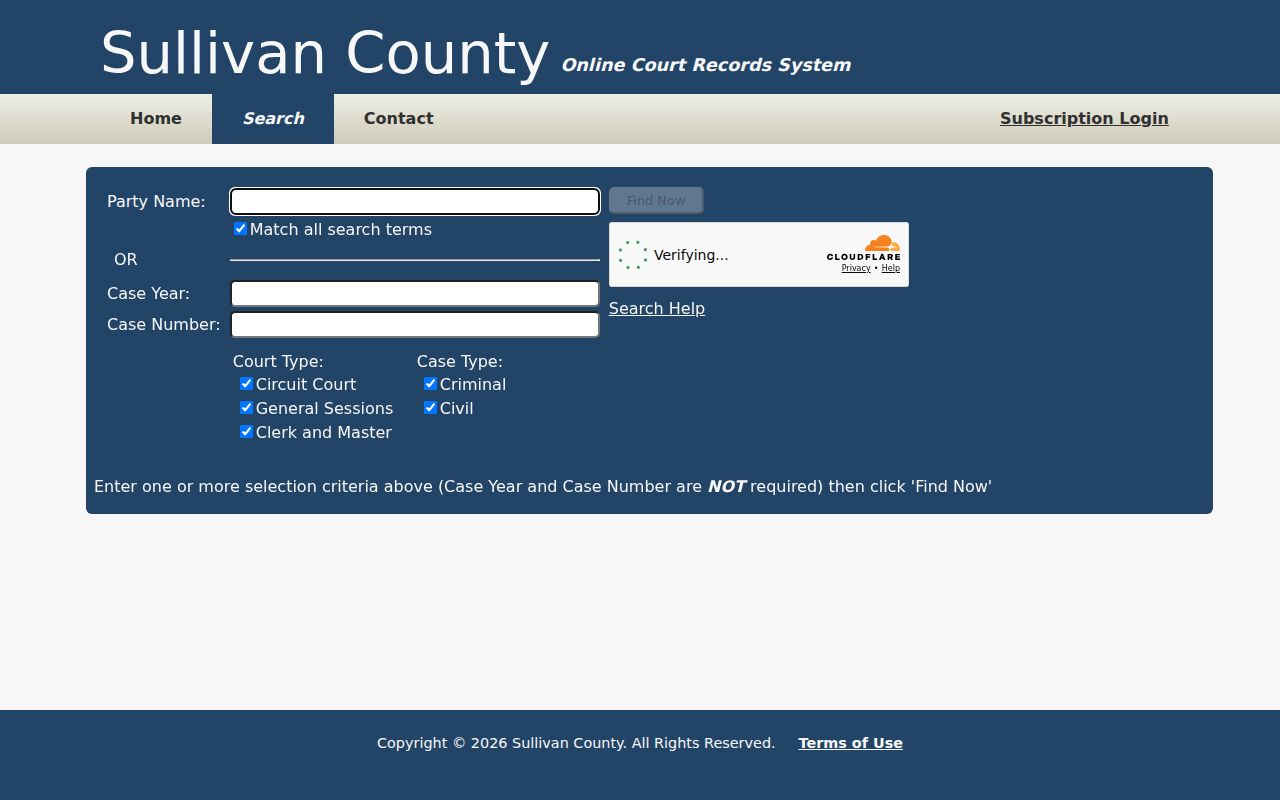
The checkboxes serve a real purpose. They keep a civil name search from turning into a sweep of every court in Sullivan County.
| Field | Use | Limit |
|---|---|---|
| Party Name | Find a plaintiff, defendant, petitioner, or respondent | Exact format help is not stated |
| Case Year | Narrow a common name | Accepted range is not stated |
| Case Number | Target one civil file | Validation format is not stated |
| Court Type | Choose Circuit, Sessions, or Clerk and Master | Municipal and Juvenile are absent |
Civil Dockets: What They Show
Read a civil docket entry in a set order. Confirm the status and court. Find the case number and style. Note the filing date and category, then compare the next court date against any disposition date. A category like Malpractice or Personal Injury tells you the kind of filing, not who won.
| Case number | A local identifier such as 82CC1-2023-CV-3852. |
|---|---|
| Case style | The formal caption identifying the parties. |
| Filing date | The date the clerk recorded the case or filing. |
| TCA description | A Tennessee code or filing-category label. |
| Primary attorney | The attorney and role shown in the report, not necessarily all counsel. |
| Next court date | The next setting displayed at the time of the report. |
| Disposition date | The recorded closing date, blank in an open sample row. |
The docket screen lists entries, not paperwork. Downloadable pleadings, judgments, exhibits, and financial detail are document questions for the clerk.
Sullivan Civil Docket Case Numbers
The sample 82CC1-2023-CV-3852 seems to pack in a Sullivan Circuit identifier, the filing year, a civil marker, and a sequence number. Treat that as one example, not a guarantee. Type the case number exactly as it appears on court paper. Add or drop a character and the search may miss the match.
- CV
- The civil marker in the observed sample number.
- Case style
- The formal title naming the parties.
- Open
- A high-level status showing no displayed final disposition in that report row.
- Docket entry
- One dated filing, event, setting, order, or action.
A failed number is not the end. Search by party and year instead, then compare court type. The same names can show up in Circuit, Sessions, or Chancery matters without sharing one file.
What Cases Fill the Civil Docket
Civil work in Sullivan County splits by subject and jurisdiction. Circuit civil dockets carry labels such as Wrongful Death, Malpractice, Personal Injury, Condemnation Lawsuit, and Category 1 Filing. General Sessions hears small claims and other civil matters within statutory limits. Chancery takes a broad range of equity, probate, and domestic filings.
| Court | Common civil work | Custodian |
|---|---|---|
| Circuit Court | Tort, contract, property, and other trial-level civil suits | Circuit Court Clerk |
| General Sessions | Small claims and civil matters within its limits | Circuit Court Clerk structure |
| Chancery Court | Probate, divorce, conservatorship, equity, and partition | Clerk and Master |
The County Clerk is a different office entirely. It keeps licenses, marriage, vehicle, tax, and commission records, not civil lawsuit files or Chancery orders.
Sullivan Civil Dockets by Court
Chancery work is not just civil Circuit Court under a second name. Its files can hold civil summonses, probate petitions, conservator materials, and divorce papers. Creditor notices, partition notices, and small-estate orders round out the list in the Clerk and Master forms index. Those samples show the kinds of filings that may land in a Sullivan County Chancery docket. They do not prove any specific case exists. And no sample form tells you how a case ended.
For the court itself, turn to the official Sullivan County Chancery Court page, which lists the Clerk and Master as its own separate route.
This split matters when a probate or equity search turns up nothing in Circuit. Katharine Jennelle serves as Clerk and Master. Call 423-323-6483 in Blountville, 423-989-4363 in Bristol, or 423-224-1726 in Kingsport.
Hearings on the Civil Docket
A next court date can mean many things. It may be a motion, docket call, non-jury matter, or jury trial. Sullivan local rules layer deadlines onto major civil motions. Motion-to-dismiss and summary-judgment packages follow a 10-working-day, 6-working-day, and 3-working-day exchange sequence before the hearing. Proposed and competing orders have their own filing windows too.
Some contractor and homeowner fights, commercial-development cases, and boundary-line disputes must go through mediation first. That is why mediation, a motion, a continuance, or an order may precede any trial setting. The docket records each of those steps. It never promises a listed setting is the final hearing.
Civil flow: Complaint or Petition › Service › Motion or Response › Setting › Hearing or Trial › Order or Judgment
Finding Sullivan Civil Docket Settings
Start with the latest TnCIS detail or the posted Circuit docket sounding. Then compare later entries. The county's published PDF is a trial-setting report, not a full daily calendar. It can show Next Court Date, status, case number, case style, filing date, attorney, and disposition date. Judge and courtroom are not part of its header.
A disputed date calls for a phone call. Reach the Circuit Clerk or Clerk and Master office that holds the case. Local rules require judicial approval for a continuance. An old PDF or screen can be superseded. A later order or clerk update controls. The Sullivan County court schedule explains the local docket-sounding routes. Note: Keep the exact setting text, because Sullivan County publishes no universal online reset-code glossary.
Who Can See Civil Dockets
Tennessee Supreme Court Rule 34 opens most Sullivan County court records to the public. Some things stay closed, though. Sealed files, judicial work papers, protected records, and anything a statute or court order shields can be withheld from a docket search. Sullivan County adds its own layer of privacy. Local rules call for redacting Social Security numbers, credit-card and loan-account numbers, and contact details protected under an Order of Protection.
Public row, limited file: A docket event may remain visible even when its attachment is sealed, unavailable online, or released only in redacted form.
Family and probate files can be a mix. The same Sullivan County case may hold public entries next to restricted ones. Rather than assuming a missing image means no record exists, ask the Clerk and Master how access works for that file.
Request Sullivan Civil Docket Documents
A docket is only an index. The judgment, order, pleading, exhibit, minute entry, or certified copy itself lives in the underlying court file. Local Rule 12 lets you ask to inspect files, minute books, and Laserfiche material. You can ask either orally or in writing. Copy requests are different. They must be written and paid ahead of time. The clerk can bill for labor that runs past five hours.
Give the clerk a clear picture of what you want. Name the court, the case number, and the document title or docket event. Add the rough filing date and the copy type you need. Ask whether a plain, certified, or redacted version exists. Request an estimate before sending money, since per-page and certification fees vary. For older material, ask which items sit in paper files, minute books, or Laserfiche.
A narrow request moves faster through the Sullivan County civil docket. Say whether you seek a complaint, motion, order, judgment, exhibit, or minute. A public row may show with no image. The document may be sealed, protected, not digitized, or offered only in redacted form. The docket date helps the clerk pin down the exact filing. Cases that moved between courts often carry two case numbers. A case that drew an appeal may carry two as well. Give both so the office can confirm the link.
Note: A certified copy is clerk-authenticated and differs from a free TnCIS docket view.
Sullivan County's public-record policy rewards this care. When prompt production is not practical, the office can send a written response within seven business days. That response may state a denial, an estimated completion time, or copying charges. That is not a guarantee. Full production can take longer than seven days. A sealed item, a protected identifier, or a record held elsewhere may call for another response. Keep the request tight. Save the clerk's estimate, so the precise civil record turns up with less delay.
Routing matters too. Send probate and equity requests to the Clerk and Master. Use the Circuit Court Clerk structure for Circuit or Sessions civil records. The right address saves days of transfer.