
Sullivan County Court Record Requests
Start with the Sullivan TnCIS case search. It covers Circuit, General Sessions, and Clerk and Master matters. Write down the case number. Note the exact event or document name and its filing date too. Those specifics narrow the request and cut the clerk's search time. When no image appears, call the office or visit the counter. You can also ask for inspection or copies under Local Rule 12.
- Identify Circuit, General Sessions, Juvenile, Chancery, or city court.
- Search the case and record its number and style.
- Name the pleading, order, judgment, minutes, or exhibit needed.
- Choose inspection, plain copy, certified copy, or redacted certified copy.
- Ask for current charges and pay by the clerk's stated method.
A second written channel is the county request landing page. A phone call can sort out which office holds the file. Copy requests under the local rule, though, must be in writing.
Three Records, Three Uses
Three things get confused, so keep them straight. A docket is only an index and event trail. The filed document is the real complaint, motion, or order an entry names. A certified copy carries the clerk's authentication for official use. Seeing one of these does not guarantee access to the rest.
| Record | What it provides | How to seek it |
|---|---|---|
| Docket | Chronological case events | TnCIS or clerk |
| Filed document | Text and attachments | Inspection or copy request |
| Certified copy | Clerk-authenticated record | Request certification |
An online row can stay visible even while its attachment is sealed, redacted, or simply unavailable online. So name the exact item you need rather than asking vaguely for "the court record."
Kinds of Court Records
The Circuit Court Clerk page lists complaints, petitions, summonses, orders, warrants, executions, subpoenas, daily minutes, exhibits, appeals, collections, and disbursements. The Chancery forms collection covers the rest. It shows probate petitions, oaths, waivers, accountings, conservator papers, divorce affidavits, restraining orders, partition forms, publication notices, and small-estate orders.
- Case files and chronological docket sheets
- Complaints, petitions, motions, and responses
- Summonses, returns, subpoenas, and warrants
- Signed orders, judgments, and daily minutes
- Exhibits, appeal records, and permitted financial records
City citation and ordinance records sit with the municipal clerks. The County Clerk keeps county-government, license, marriage, and commission records, not the main court files.
Which Sullivan Custodian Gets It
The main Circuit Court Clerk office sits at 140 Blountville Bypass, Blountville, phone 423-279-2752. Bristol Law and Sessions numbers are 423-652-1030 and 423-989-4352. Kingsport uses 423-224-1724 and 423-224-1711. The Clerk and Master holds Chancery and probate material, at Blountville 423-323-6483, Bristol 423-989-4363, and Kingsport 423-224-1726.
Sullivan County Circuit Court Clerk
140 Blountville Bypass
Blountville, TN 37617
423-279-2752
Juvenile requests go to that court's own custodian, and city requests go to the city clerk. A county public-record request cannot route around the office that actually holds the file.
Clerk and Master Document Families
The official Clerk and Master forms index shows the document families handled outside the Circuit Clerk's usual route.
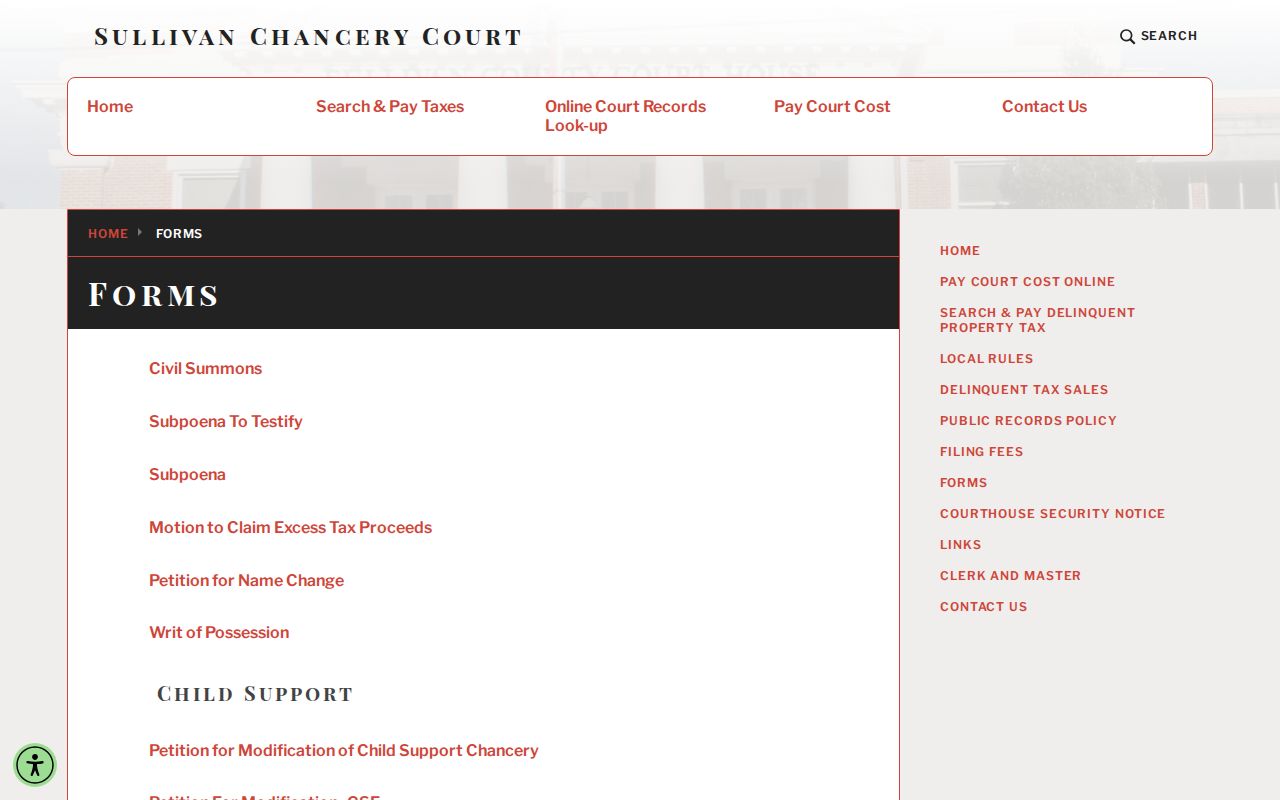
Those categories help you name a probate, conservatorship, divorce, partition, or small-estate item. The index gives vocabulary and custody, but it does not make every filed document downloadable.
Court Records: What They Contain
A file grows as the case moves. A petition or complaint opens most civil matters. Summonses with their returns show process activity. Motions ask the court to act. Orders capture a judge's direction. A judgment may settle an issue or end the case. Criminal files can add warrants, charging papers, pleas, bond activity, and disposition records.
| Case Number | The unique court identifier, such as C46200 in one local sample format. |
|---|---|
| Pleadings | Complaints, petitions, answers, and motions. |
| Orders | Signed judicial directions and rulings. |
| Docket Sheet | The dated index of events. |
| Exhibits | Filed evidence or attachments, subject to access rules. |
A Sullivan County docket entry names the filing, but the paper itself still holds the details.
Seven Business Days Explained
The county Public Records Request form asks for a name and Tennessee residence. It also wants a response contact, a description, and citizenship. You must choose Inspection or Copy/Duplicate. The description box works best when it lists exact items. Think of a final order, a daily-minutes entry, or a docket sheet through a stated date. Keep each case in its own entry. That helps the custodian estimate the work and the charges, and it keeps unrelated matters from tangling together. Skip protected details the office does not need to locate the court file.
County policy calls for prompt access when practicable. When prompt production is not practical, the custodian has seven business days to respond. The response may be a denial, an estimated completion date, or copying charges. Treat that as a response framework. It is not a promise that every record arrives within seven days. A narrow request should name the court and the case number. Add a filing or setting date and the exact item. If access is denied, keep the written explanation.
Sometimes the office will say another custodian holds the material. Note the referral and send a revised request to that office. Circuit Court Clerk, Clerk and Master, Juvenile, and municipal operations stay separate even though they all serve the same county. A written response that explains denial, timing, or costs creates a useful record of what was asked. It also shows what remains outstanding. Tennessee Public Records Act guidance explains the citizen-access baseline.
Copy Fees and Certification
Local Rule 12 splits free looking from paid copying. Any Tennessee citizen can ask to inspect a file, minute book, or Laserfiche record. The request can be oral or written. Copies work differently. You must ask in writing and pay up front. Cash, money order, or cashier's check will do. If a copy job runs past five hours, the clerk may bill for that time too.
| Item | Researched charge |
|---|---|
| File or minute-book inspection | No charge under Local Rule 12 |
| Plain copies | Current amount must be obtained from clerk |
| Certification | Current amount must be obtained from clerk |
| Clerk search time | May be charged beyond five hours |
The clerk sets per-page and certification charges, so ask for an estimate before making a broad request. One note on certified copies: for a non-attorney or court employee, the copy may state that it was made from a redacted copy.
When TnCIS Has No Image
Not every piece of a case lives in the clerk's regular file. A transcript usually sits with the court reporter. An appellate record travels with the appeal once it is transmitted. Exhibits may be locked down by handling rules or a special court order. So before you assume a document from a hearing is in the public file, ask the clerk whether it is even in their custody. If it is, request whatever releasable version they can provide. Accept any lawful redaction that comes with it.
When a docket entry shows no image, write down the entry's title and date first. Then ask the clerk a simple question: can the document be inspected, copied plainly, or certified? There are several honest reasons an image may be missing. Portal design and custody play a part. So can a sealed attachment or a required redaction. A blank screen proves nothing more. The document may well exist even when no image appears alongside the docket entry.
Request language: identify the court and case, name the exact event, give its filing date, and state whether inspection or a copy is needed.
For probate material, skip the generic labels and name the exact item: a petition, an oath, a waiver, an accounting, a notice, or an order. The Clerk and Master can then tell you which of those components is actually maintained and what can be released.
Access Rules for Court Records
What happened after filing also shapes where you ask. A transcript, an appeal record, daily minutes, and an exhibit are four different animals. Take Circuit, Criminal, General Sessions, or Juvenile material to the Circuit Court Clerk. Chancery, probate, and equity documents belong with the Clerk and Master. An ordinance case from Bristol, Kingsport, Johnson City, or Bluff City is different. That one starts with the city's own municipal custodian.
Think about what you truly need before you request. Inspecting the file in person works well for a thick record. You can mark only the pages worth copying. A plain copy is the right call when you need to take the material out of the office. Certification is a separate step for when another office demands authenticated copies. Checking the inspection or copy box on the county form does not promise certification or electronic delivery.
Hang onto the clerk's response and any cost estimate. Broad requests may trigger clarification and extra search time. A request can span many years. It may name no specific court, or seek everything on a general subject. Give Sullivan County staff something concrete instead. A complaint filed near a known date works. So does a signed final order. If the case went up on appeal, carry the appellate case number for the later file. Keep the trial-court number for the original record.
Tennessee Supreme Court Rule 34 opens case, administrative, and judicial records to the public while preserving exceptions. Sealed materials and confidential records may be withheld. So may judicial drafts and notes, internal case management systems, and anything whose release would frustrate a judicial function. T.C.A. §§10-7-503 and 10-7-504 supply the public-access and confidentiality rules. Section 10-7-505 offers a judicial-review path when access is disputed.
Protected data: Sullivan rules call for redaction of Social Security numbers, credit-card and loan-account numbers, and protected Order-of-Protection addresses and telephone numbers.
Sealed envelopes stay closed without a court order. Juvenile records travel a separate restricted route, so when an attachment is withheld, ask the clerk which rule controls.