
Sullivan County Criminal Docket Searches
The Sullivan County Online Court Records System is the main online docket search. Most people call it TnCIS. Pick Criminal on the public form. Then narrow the court type to Circuit Court or General Sessions. Party Name, Case Year, and Case Number sit in separate fields. Expect a possible CAPTCHA before the search runs. A common surname can flood you with results. Add the year or the full case number when you can.
Online docket access is only one channel, though. If a result seems unclear, call the Sullivan County Circuit Court Clerk office for the venue. You can also stop at the clerk counter. Or file an oral inspection request or a written copy request under Local Rule 12. The clerk can also tell you whether the case actually belongs to a different system.
- Open TnCIS and select Criminal under Case Type.
- Choose Circuit Court or General Sessions based on the charge and stage.
- Enter the party name, case year, or case number, then complete the challenge.
- Open the matching row and compare its court, style, status, setting, and disposition fields.
- Ask the proper clerk for inspection or a copy when the public display is incomplete.
Sullivan Criminal Docket TnCIS Filters
The TnCIS landing page offers two things: a public court-record route and a subscription login. You do not need the login for the public docket search. TnCIS caps a single search at 2,500 rows. It stays quiet about its full date coverage. The same goes for its refresh schedule, free document-image access, and any complete event-code list. The filters matter. The reason is simple. This layer covers Circuit, General Sessions, and Clerk and Master records for the county court. It does not reach city, juvenile, appellate, or federal matters.
The official Sullivan TnCIS landing page is the public entry point.
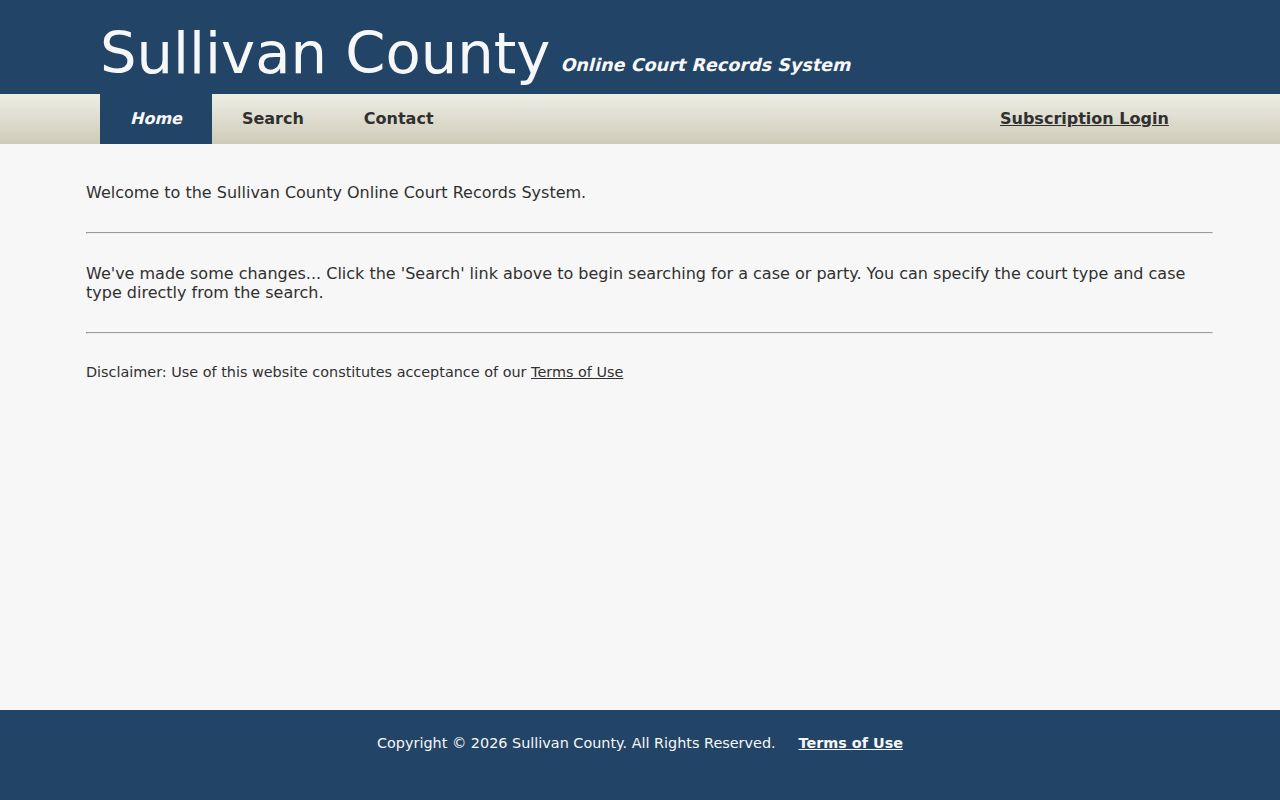
This view helps distinguish public court access from the separate subscription control.
Criminal Dockets: What They Show
Read a Sullivan County criminal docket as an event trail, not a full case file. Confirm the court and the case style first. Then follow the dated entries in order. The county's published docket-sounding reports confirm several useful labels. Remember, though, that those reports are only setting slices, and they do not expose every field a full TnCIS detail view might contain.
| Case number | The court's identifier; preserve its exact form rather than guessing a criminal prefix. |
|---|---|
| Case style | The caption, often naming the State and defendant in a criminal matter. |
| Charge or TCA description | The displayed Tennessee Code or filing description, when supplied. |
| Status and events | Open or disposed status plus dated filings, motions, or orders that the portal displays. |
| Next setting | The next court date shown for that record, subject to later reset or order. |
| Disposition | The recorded outcome or closing action; the exact text should not be expanded beyond the display. |
Bond, plea, sentence, restitution, probation, capias, and warrant details can all live in a fuller case record. The public docket-sounding samples show only some of them. Ask the clerk about any specific entry that seems missing.
Sullivan Criminal Docket Status Terms
A short set of status terms makes the Sullivan County criminal court docket much easier to read. Status words are not interchangeable, and one event rarely tells the whole result.
- Arraignment
- A court appearance where the charge and plea process are addressed.
- Setting
- A scheduled court event, which may be a hearing, docket call, or trial.
- Disposition
- The outcome or closing action recorded by the court.
- Continuance or reset
- A move of a scheduled matter to a later date.
- Capias
- Court process directing law enforcement to take a person into custody.
An Open status with no disposition date does not prove the case has no later events. It means only that the displayed row lacks a date in that field. Keep any abbreviation you cannot decode, and ask the Sullivan County clerk what it means in that case.
Criminal Case Stages on the Docket
A felony or major criminal matter can pass through several events. General Sessions may handle an early stage. The case then moves up to Criminal Court. Some cases end by dismissal, plea, or diversion; others go on to trial and sentencing. The docket records what actually occurred. Never assume every case follows the same path.
Docket flow: Filing › Arraignment › Pretrial › Plea or Trial › Disposition › Sentencing
Read each step with its date and its court. A charge entry is not a conviction, and a setting is not proof the hearing took place. A blank disposition field is not an acquittal or a dismissal; later orders and entries control the history.
Sullivan Criminal Dockets Split by Court
Sullivan County has no single criminal counter. Not every charge lands in one place. Felony and major trial proceedings point to Circuit and Criminal Court. Misdemeanor, preliminary, and some traffic-related matters often begin in General Sessions. Municipal ordinance and city traffic citations stay with the municipal court named on the citation. Juvenile delinquency follows a separate, privacy-protected route.
| Route | Typical docket | First check |
|---|---|---|
| Circuit/Criminal Court | Felony and major trial proceedings | TnCIS Criminal plus Circuit Court |
| General Sessions | Misdemeanors and preliminary proceedings | TnCIS Criminal plus General Sessions |
| Municipal Court | City ordinance and many city traffic cases | The issuing city's clerk |
| Juvenile Court | Juvenile delinquency matters | Separate juvenile clerk process |
One incident can create records in more than one court. That does not make the systems duplicates. Match the issuing authority, the court name, and the procedural stage.
Sullivan County Criminal Docket Courts
The Sullivan County Circuit Court Clerk keeps every docket. The office covers Circuit, Criminal/Law, General Sessions, and Juvenile cases. Bobby L. Russell's office runs through three county justice-center locations. Blountville Circuit answers at 423-279-2752. Bristol Law and Sessions use 423-652-1030 and 423-989-4352. Kingsport Law and Sessions use 423-224-1724 and 423-224-1711. The official county office view identifies that three-location structure.
Those direct lines help. The docket does not always show whether a case sits in Law, Sessions, Juvenile, or another venue.
The TnCIS form skips municipal and juvenile cases. An appeal creates its own record in the Tennessee appellate Public Case History. Federal criminal matters in the Eastern District of Tennessee belong to the federal court system.
Changed Sullivan Criminal Docket Dates
A Sullivan County docket-sounding PDF can go stale fast. Dates change, and the local rules make that easy to miss. Counsel cannot continue a criminal case just by telling the clerk; a judge must approve it, and the moving side drafts the order. Closures reset hearings too. Read the event history first. Then confirm the setting with the office that controls it.
Suspect a changed hearing? Line up the old setting against later entries and scan any current county or city closure notice. Then call the Law or Sessions line that handles the case. A saved screen or old PDF is never the last word on a Sullivan County court date.
Date check: A missed criminal setting can have serious case effects. Contact the court at once rather than waiting for the portal to change.
Access Rules for Criminal Dockets
Tennessee Supreme Court Rule 34 lets the public inspect court records. The rule bends only when a specific exception applies. The Tennessee Public Records Act supplies some of those exceptions. The rule sorts records into case, administrative, and judicial buckets. Sealed material and protected records may be withheld from a docket search. So may judges' work papers, drafts, and internal case-management files.
Key rules:
Rule 34 supplies the court-record access framework and recognizes legal and court-order limits.
T.C.A. § 10-7-503 establishes the Tennessee citizen inspection right, subject to exceptions.
T.C.A. § 10-7-504 protects confidential records and information.
Sullivan County local rules require redaction before anything goes public. Social Security numbers come out. Credit-card and loan-account numbers go too. Order-of-Protection addresses and phone numbers get protected. Even so, seeing an event on a docket does not guarantee access to its attachment. Sealed and juvenile matters go through the clerk's own access process.
Requesting Sullivan Criminal Docket Copies
A free docket display is not a certified copy. Local Rule 12 lets you ask, orally or in writing, to inspect a file, minute book, or Laserfiche record. Copy requests must be written, and you pay in advance. After five hours of labor, the rule permits a time charge. No universal per-page or certification amount is set, so confirm the charge before ordering.
When you contact the clerk, name the court, give the exact case number if you know it, describe the filing or event, offer an approximate date, and say whether you want inspection, a plain copy, or a certified copy. Older Sullivan County criminal records may live on paper, in minute books, or in Laserfiche rather than as a public web image. One caution on certified copies: if the clerk certifies from a redacted copy, the local rule requires that fact to be noted.
Note: Direct the request to the court custodian, since the County Clerk does not keep the primary Sullivan trial-court docket.
For an old Sullivan County case, give a broad date range and ask which storage form holds the record. Minute books and Laserfiche can preserve material that never appears online. Same-name cases are common, so use the court, the filing year, and the caption to tell them apart. Ask for a named item rather than guessing at the file's contents. The clerk can walk you through formats, access limits, estimated work, and payment steps before producing the record.